Modern challenges don’t wait—and neither can we.

As General Stanley McChrystal writes in Team of Teams, today’s problems are complex, fast-moving, and interconnected. Cause and effect is often unclear. By the time you’ve mapped the system, it has already changed.
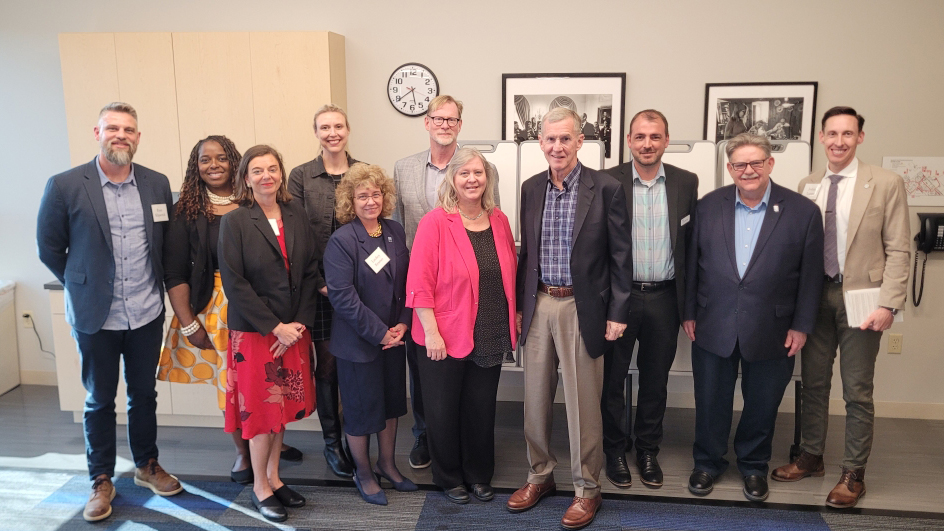
Last week, pathways partners got to meet with General McCrystal, and discuss how homelessness is exactly this kind of complex challenge. Special thanks to the Gerald R. Ford Presidential Museum for making this possible.
We covered how well-intentioned systems are often slowed by:
- Silos that limit information sharing
- Structures that prioritize process over outcomes
- Planning cycles that delay real-world action
Meanwhile, we desire progress now, not after the next strategic plan. Pathways partners are leaning into a culture of action. Through initiatives like 100 in 100 Kent County and the national Built for Zero framework utilized by the Coalition to End Homelessness, partners across business, government, and philanthropy are working differently by:
- Sharing real-time data
- Meeting more regularly (and often talking daily)
- Solving problems collaboratively as they emerge
This approach isn’t perfect. But it is responsive and it is working. Think of it less like building a blueprint and more like building the plane while flying it. This doesn’t mean abandoning planning. It means refusing to let planning become the bottleneck.
One example of adaptability from 100 in 100 is flexible funding. Housing placements for individuals who have sometimes been unhoused for years were delayed by small financial barriers: security deposits, application fees, or basic move-in costs. The system sometimes had resource for this, but they were often too slow or too rigid.
As one provider put it: “Housing referrals would move in six weeks to never.”
Partners identified the problem and asked the Greater Grand Rapids Chamber Foundation with support from partners including Corewell Health, AHC+ Hospitality, LMCU, the Jandernoa Foundation, DeVos Family Foundations, and Kent County to create a rapid-response funding approach to allow case managers to act immediately.
The results:
- An average of just ~$500 per person housed (not all required resources)
- Supporting a more than 105% increase in housing placements
- Faster transitions from referral to permanent housing
The Lesson: Progress beats perfection
As McChrystal puts it: in complex environments, speed of learning and alignment beat perfection and control.
In his discussion with us, he simplified three priorities to address complex challenges:
- Shared vision and purpose
- Real time information sharing (across and within organizations)
- Empower frontline leaders to act
What this means for our community
The work underway in Kent County offers a broader lesson, not just for homelessness response, but for how we tackle any complex regional challenge.
100 in 100/Pathways has made progress on shared vision and purpose. But after speaking with General McCrystal, our debrief showed consensus that we need to prioritize our efforts on real time information sharing and empowering our teams to act.
Systems change doesn’t happen from the sidelines. It happens when partners stay at the table (yes, we have our arguments), move quickly, and commit to continuous improvement even when the path isn’t perfectly defined.
If we want different outcomes, we need less waiting and more doing. Because in the end, the goal isn’t a perfect plan. It’s a community where everyone has a place to call home.